Problem solving with process thinking - part 1
- Authors
- Name
- Andy Cao


Table of content


Unleashing Your Problem-Solving Potential: An Introduction to Process Thinking
Over the years, I've experimented quite a few problem solving approaches—like fishbone diagrams to find root causes and the “5 Whys” to uncover the hidden reasons behind a problem. Yet, no matter how thorough I thought I was, I'd still end up missing key details or scrambling at the last minute. Also, the natural of these frameworks introduce logic dependencies between each step. That's why I find more helpful in applying process thinking: a step-by-step method to visualise every stage of an activity in sequence.
I'm not claiming process thinking is the one-and-only solution for everyone. It's simply helped me and my teams spot missed steps, organise tasks, and avoid nasty surprises. In this post, I'll walk you through the basics of process thinking and how it can be a useful in your problem-solving toolkit.
Why Process Understanding Is Key to Problem-Solving
Whether you're developing a software product, organising a large event, or running a restaurant, one principle remains remarkably consistent: understanding your end-to-end process is the single best way to unclog complex situations. By seeing your work as a connected chain of steps—where each task depends on the previous ones—it becomes far easier to detect exactly where a problem lies and how to fix it. Often, what appears to be a major crisis is merely a small blocker in the workflow—like an overlooked dependency or a delayed hand-off—that, if left unresolved, can snowball into a much larger headache. Having a clear, step-by-step view of your operations allows you to address these minor issues before they spiral out of control, no matter the industry or scale of the project.
Process thinking involves:
- Listing every single stage of an activity.
- Placing each stage in a logical, chronological, or structural flow.
- Spotting “pressure points” that can derail the whole operation if not done correctly.
It's like a detailed roadmap for the entire operation, so you and your team can coordinate and respond quickly, whether your field is food service, event management or software development.
A Simple Real-World Example: Serving a Meal in a Restaurant
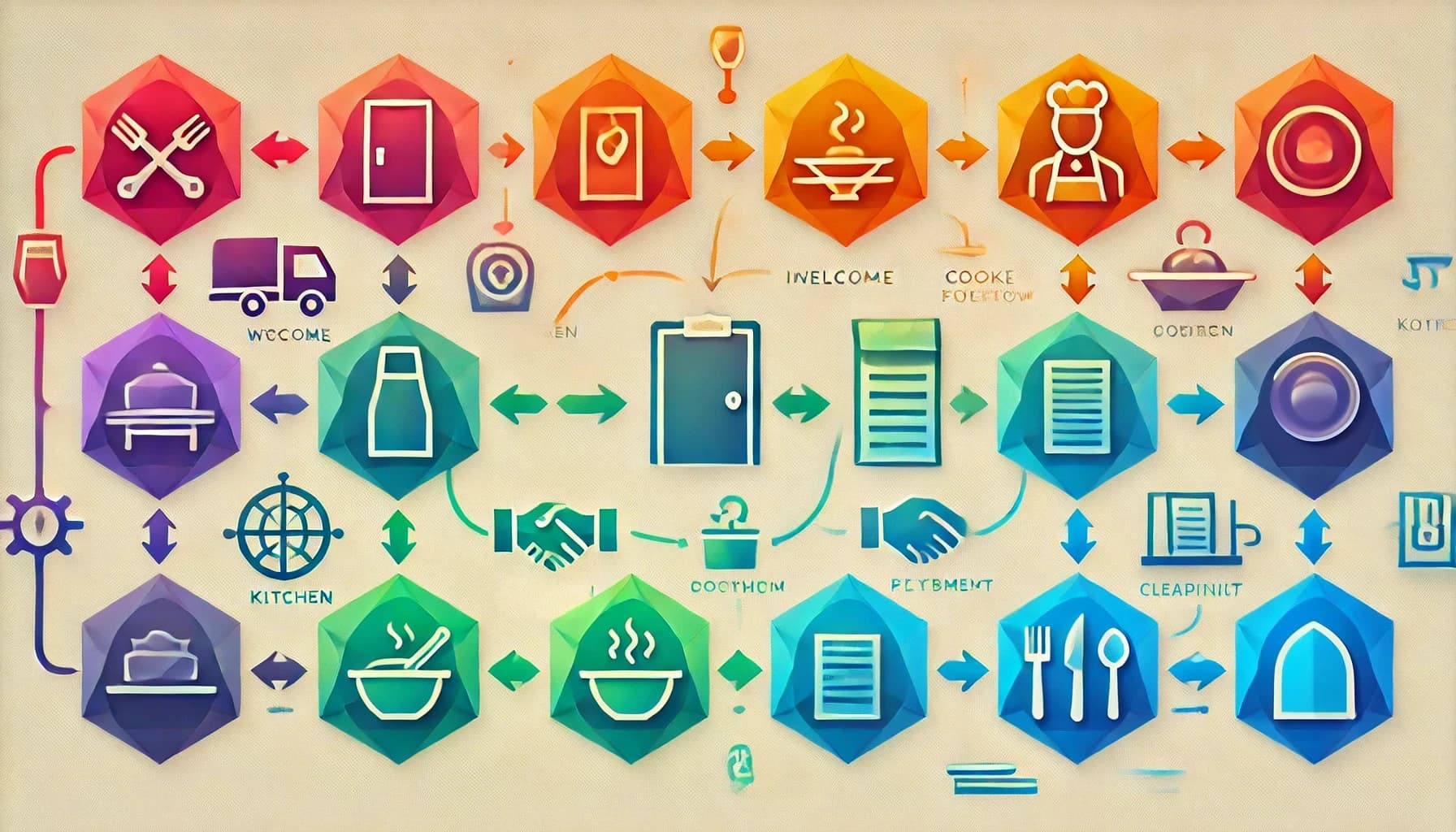
Welcoming Diners
- Greet at the Door: A host or server says hello, checks if the group has a reservation, and manages the queue if there's a wait.
- Seat the Guests: Guide them to the best table for their party size, ensuring the table is set properly (cutlery, napkins, condiments).
Introducing the Meal Experience
- Menus & Specials: Hand out menus, highlight any specials or seasonal items.
- Initial Interaction: The server offers water or an introductory beverage, gauging any dietary restrictions.
Taking Orders
- Order-Taking: Confirm diner preferences (allergies, spice levels).
- Suggest Pairings: If the restaurant's style allows, recommend particular sides, desserts, or drinks.
Kitchen Workflow
- Communicate Orders: The server enters or relays orders accurately so the kitchen knows exactly what to prepare and in what sequence.
- Cooking & Plating: Each dish is timed so starters, mains, and sides arrive neither too soon nor too late.
- Quality Check: Before leaving the kitchen, a quick inspection ensures correct presentation and food quality.
Serving the Meal
- Course Delivery: Serve courses in the right order, ensuring minimal wait between dishes.
- Table Maintenance: Clear used plates promptly, top up drinks, and respect diners' personal space.
Checking In
- Mid-Meal Follow-Up: A brief stop at the table to confirm satisfaction or handle small issues (missing cutlery, extra sauces).
Payment & Feedback
- Bill Presentation: Offer the bill at the right time (not so early it feels rushed, not so late it causes frustration).
- Payment Process: Provide payment options, handle them smoothly, and thank customers sincerely.
- Feedback Opportunity: Invite diners to leave comments or share quick feedback on their experience.
Post-Service Cleanup
- Table Reset: Clean and re-set quickly for the next customers.
- Daily Review: Staff discuss any notable incidents or repeated requests, refining the service for tomorrow.
Pinpointing “Pressure Points”
Mandatory Dependencies
- These are steps that must happen before others can begin. For example, in the restaurant context:
- Order Entry is a mandatory dependency for kitchen prep. The kitchen can't start cooking without a clear, accurate order.
- Table Clean-Up is mandatory for seating new customers. A guest cannot be seated at a table until it's cleared, wiped, and reset.
- Missing a mandatory dependency creates an immediate bottleneck or error. An unentered order means nothing gets made; an uncleared table means new customers can't sit, leading to a backlog at the door.
- These are steps that must happen before others can begin. For example, in the restaurant context:
Discretionary Dependencies
- These are steps that could theoretically happen in various sequences, depending on preference, convenience, or best practice. They aren't enforced by strict rules or physical constraints. For instance:
- Suggesting Pairings could occur while taking the initial drink order or just after the guest decides on a main course. The order of these tasks is flexible.
- Daily Review might be completed at the end of a shift or first thing the next morning. As long as it's done regularly and all relevant staff are informed, there's some leeway.
- These are steps that could theoretically happen in various sequences, depending on preference, convenience, or best practice. They aren't enforced by strict rules or physical constraints. For instance:
With that in mind, here are the main pressure points to keep a close eye on:
- Order Accuracy: A single misheard order can ruin a meal, leading to complaints or wasted food. This is a mandatory dependency (server must record the order properly before the kitchen can act).
- Coordinated Timing: Mains ready too soon can go cold; starters delayed leads to impatient diners. Ensuring the kitchen and servers coordinate effectively might involve both mandatory steps (kitchen can't start cooking until the server keys in the order) and discretionary timing (servers can choose when to bring out appetisers based on table pace).
- Prompt Issue Resolution:A minor oversight—like a misuse of ingredients can escalate if not addressed quickly. Identifying a discretionary dependency here means there's no hard rule about when to check on diners, but you still need timely interventions to keep guests happy.
- Smooth Payment & Farewell: Rushing or delaying the bill can taint an otherwise positive experience. How and when you present the bill can be considered discretionary, but doing it well is crucial.
Process thinking highlights these friction points so you can prevent small glitches from becoming disasters. And if something does go wrong, you know exactly which stage to re-check or improve.
Why Understanding Business Process Is Vital
- Prevents Oversights: A clear process helps you catch details (like condiments or cutlery placement) that might otherwise get overlooked.
- Streamlines Complex Projects: When you break down tasks into logical steps—whether it's hosting diners, writing software, or organising a conference—you see dependencies you might have missed.
- Unclogs Problem Areas: If you ever find your project stuck, refer back to your business process map. Very often, the holdup is a single bottleneck—like staff scheduling, miscommunication, or a missing mandatory step—rather than the entire operation.
- Applies Across Industries: Serving a restaurant meal is just one setting. The same principles apply to developing a software product, where each build phase relies on the previous one's success, or organising an event, where speaker scheduling depends on venue availability and tech setup.
In short, if you ever get stuck with a problem, going back to business process clarifies the path forward. It lets you isolate exactly where things went off track and rapidly fix that specific link in the chain.
My Own Experience
Personally, I've applied similar logic in settings beyond this restaurant example, from managing software release cycles to executing multi-stage product delivery. Each time, process thinking offered clarity. Rather than feeling overwhelmed by a million tasks, I could see the entire business process at a glance—pinpointing the steps that needed attention.
I'm sharing these insights understanding that there's no one-size-fits-all blueprint. But in my experience, mapping out workflows has prevented a lot of frantic patch-ups, last-minute confusion, and frustration for everyone involved.
Final thought
Process thinking shows that how we do things can be just as crucial as what we do. Mapping out every single step of a restaurant's meal service not only highlights potential pitfalls but also demonstrates the importance of understanding the overall business process for effective problem-solving. If you ever find yourself stuck—be it in a kitchen during dinner rush, at a software product launch day, or while coordinating an event's keynote speaker—refer back to the business process. Chances are, the solution lies in clarifying and fixing a specific stage, rather than overhauling everything.
At the end of the day, no matter how large or routine your project, seeing the full process laid out gives you a sense of control and direction. It's a simple approach that helps you plan more thoroughly, respond faster, and keep your objectives on track—one step at a time.